


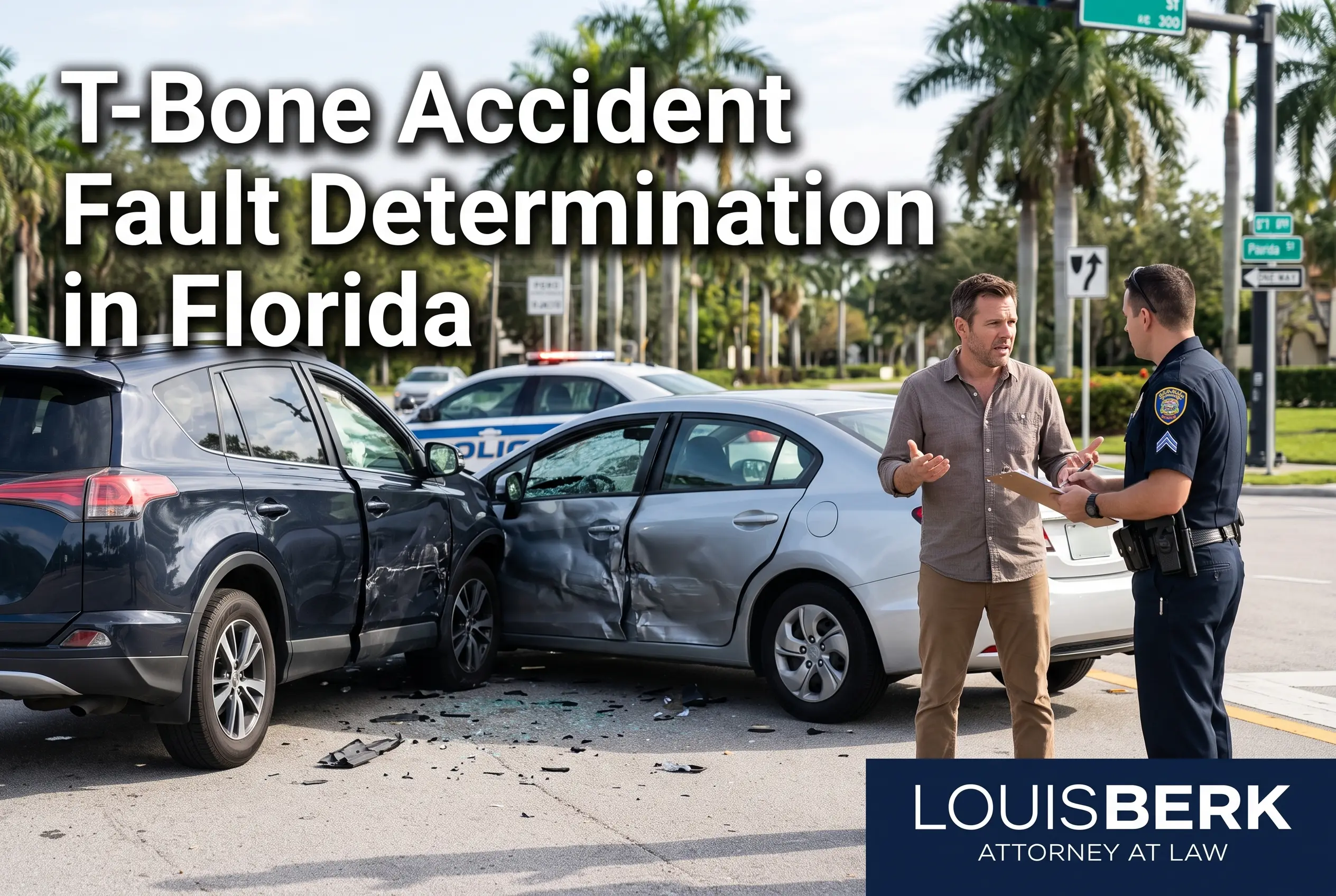
Key Takeaways: T-Bone Accident Fault in Florida
- Fault depends on Florida's right-of-way statutes and the evidence, and no automatic rule blames one driver.
- Red lights, stop signs, yield signs, and left turns each carry a specific duty under §316.075, §316.123, and §316.122.
- Even a driver on green must yield to vehicles lawfully inside the intersection under §316.075.
- A driver found more than 50 percent at fault recovers nothing, and a smaller share reduces recovery by the same percentage under §768.81(6).
- Video, vehicle data, and independent witnesses settle most disputes, so preserve evidence in the first days.
- PIP pays regardless of fault when initial treatment starts within 14 days, and a negligence lawsuit generally must be filed within two years under §95.11(5)(a).

T-Bone Accident Fault Determination in Florida
Fault in a T-bone accident turns on right-of-way rules and the evidence from the intersection. The driver who broke a signal, stop sign, yield, or turning rule is usually responsible, but both drivers sometimes share the blame.
The stakes are high. The Insurance Institute for Highway Safety (IIHS) reports side impacts caused 22 percent of passenger vehicle occupant deaths in 2024, because a car door offers little protection compared with the front or rear of a vehicle.
At Louis Berk Law, we investigate intersection crashes where each driver tells a different story. This guide explains how fault is decided, the Florida statutes behind each type of T-bone crash, the evidence settling disputes, and how shared fault affects your claim.
How Is Fault Determined in a T-Bone Accident?
Fault is determined by comparing what each driver did against Florida's right-of-way statutes, then testing both accounts against physical evidence. No automatic rule blames one driver, and an officer's opinion is not the final word.
Insurers decide fault first, because they pay claims. A jury or judge decides if the case goes to court. Both look at the same things: who had the right of way, whether a driver broke a traffic statute, and whether the other driver also acted carelessly.
A traffic violation is evidence of negligence, not a guarantee of one. The violating driver still has arguments, such as claiming the other driver was speeding, distracted, or ran a yellow light.
Who Is Usually at Fault in Common T-Bone Situations?
The answer depends on the intersection. The table below shows the most common scenarios, which driver is usually responsible, and the Florida rule behind each one.
The next sections explain each rule. Our T-bone accident team applies them to the facts of your crash.
Traffic Signals and Red Light Crashes
A driver facing a red light must stop before the crosswalk or intersection and wait for green. Under §316.075, a yellow light warns drivers not to enter once red appears, and entering on red is a traffic infraction.
Green does not give a driver unlimited rights. The statute requires drivers on green to yield to vehicles and pedestrians lawfully within the intersection. A driver who enters on a late yellow and clears the intersection still faces the question of whether the other driver left too early.
The common dispute is each driver claiming the green light. Without a video or a neutral witness, the case rests on competing accounts, so we look for cameras, signal timing records, and vehicle data right away.
Stop Sign and Yield Sign Crashes
A driver at a stop sign must stop at the line, then yield to vehicles in the intersection or approaching so closely as to be an immediate hazard. Section 316.123 sets this duty, along with the rule at four-way stops: the first vehicle to stop goes first, and the driver on the left yields to the driver on the right when two arrive together.
Yield signs carry a special rule. A driver who passes a yield sign without stopping and collides with a vehicle in the intersection creates prima facie evidence of failure to yield under §316.123(3).
A rolling stop is a common issue. A driver who slows but does not stop at the line has not met the statute, and a camera or event data recorder often shows it.
Left Turn T-Bone Crashes
A driver turning left must give way to oncoming vehicles within the intersection or so close as to constitute an immediate hazard. Section 316.122 places this duty on the turning driver.
The statute does not define "immediate hazard," so the answer turns on the facts: the oncoming driver's speed, the distance, and the turning driver's view. A speeding oncoming driver weakens the turning driver's duty only to a degree, and fault is often divided.
These crashes produce serious injuries because the oncoming vehicle strikes the side of the turning vehicle at full speed. Our guide to a car accident lawsuit explains what happens when an insurer disputes the left-turn rule.
Intersections Without Signs or Signals
At an intersection with no traffic control, the driver arriving second yields to the vehicle already inside, and the driver on the left yields to the driver on the right when both arrive together. These rules appear in §316.121.
A driver entering a state-maintained road from a side road must also yield to approaching vehicles on the main road. Rural and neighborhood intersections produce many disputes, since neither driver knows who arrived first and no camera recorded it.
When Both Drivers Share Fault
Florida divides fault by percentage, and your share reduces your recovery. Under §768.81(6), a person found greater than 50 percent at fault for his or her own harm recovers nothing in a negligence action, and a smaller share lowers the recovery by the same percentage.
The 50 percent line makes every percentage point valuable. Insurers push fault onto the injured driver with arguments about speed, lookout, and cell phone use. We answer with the evidence, because one side's account alone rarely settles the allocation.
PIP benefits do not depend on fault, so your own coverage pays even when you are blamed. Our guide to a car accident settlement explains how fault percentages shape the final number.
Evidence Proving Fault
The strongest T-bone cases rest on objective evidence gathered early. Video, vehicle data, and physical marks show what happened, and they carry more weight than memory.
- Cameras at businesses, traffic signals, and nearby homes
- Dashboard cameras and doorbell cameras
- Event data recorders storing speed, braking, and throttle data before impact
- Photographs of both vehicles, the damage pattern, and skid marks or debris
- Traffic signal timing records and the intersection layout
- Names and statements from independent witnesses
- 911 recordings and the responding officer's notes
Many camera systems overwrite footage on a short cycle, and vehicles are repaired or sold. We send preservation letters to the other driver, the insurer, and nearby businesses in the first days, so key evidence does not disappear.
What the Police Report Does and Does Not Prove
The crash report helps your claim, but it does not decide fault. Officers record observations, statements, and sometimes a citation, and insurers and courts weigh the report alongside everything else.
Under §316.066(4), statements a person makes for the crash report are barred from use as evidence in any civil or criminal trial. Under §316.066(2), reports identifying the parties stay confidential for 60 days, and the parties, their lawyers, and their insurers have access during the period.
If the report blames you wrongly, or leaves out a witness, we gather evidence to correct the record. A citation does not close a case, and a missing citation does not end one.
Passengers and Other Injured People
A passenger is rarely at fault, so a passenger has claims against either driver's insurer. Passengers also have PIP, normally through the policy on the vehicle they rode in, as discussed in our guide to a personal injury claim.
When a driver was working at the time, an employer sometimes carries liability as well. We identify the employer, the vehicle owner, and every policy before negotiating.
Injuries and PIP After a T-Bone Crash
Your own PIP coverage pays up to $10,000 in medical bills and lost income regardless of fault, if you receive initial treatment within 14 days of the crash. The deadline comes from §627.736.
Pain and suffering claims against the at-fault driver require a qualifying injury under §627.737(2): significant and permanent loss of an important bodily function, permanent injury, significant and permanent scarring, or death. Side impacts often cause the head, chest, pelvis, and spine injuries meeting this standard.
Blocked Views, Glare, and Nighttime Crashes
Limited visibility does not excuse a driver from the right-of-way rules. Where no stop line or crosswalk exists, a driver at a stop sign must stop at the point nearest the intersecting road offering a view of approaching traffic, and a driver who cannot see should creep forward until the view clears.
Parked vehicles, hedges, buses, and sun glare create real hazards, and they shift fault arguments. A visibility problem on one side sometimes lowers the driver's share, but it rarely erases the duty to yield. We photograph the sight lines at the same time of day as the crash, which shows a jury what each driver saw.
Steps to Take After a T-Bone Crash
The first hour shapes the fault dispute, so protect your health first and the evidence second.
- Call 911 and request medical help, even if you feel fine
- Photograph both vehicles, the intersection, the traffic signals and signs, and any skid marks
- Note which signal or sign controlled each direction
- Collect names and numbers from witnesses before they leave
- Get the other driver's name, insurance, and plate, and avoid discussing fault
- Get the police report number
- See a doctor within 14 days to protect your PIP benefits
Write down your own account the same day, including your speed, the signal color, and what you saw. Notes made close to the crash carry more weight than memory months later.
How Insurers Argue Fault in T-Bone Claims
Insurers look for any argument lowering their payout, and fault percentage is their favorite tool. Knowing the common arguments helps you recognize them.
- You were speeding or approaching too fast to stop
- You were distracted, often by a phone or passengers
- You entered on yellow and should have stopped
- You failed to keep a lookout for a turning vehicle
- Your account changed between the crash report and your statement
Each argument has an answer in the evidence. Data from the vehicle, timestamps from a video, or a neutral witness often resolves a point without a trial. We prepare for these arguments before the insurer raises them.
T-Bone Crashes With Commercial Vehicles
A crash with a delivery van, work truck, or tractor-trailer adds more parties and more evidence. The driver's employer, the vehicle owner, and sometimes a freight company each carry liability and insurance.
These vehicles often carry cameras and electronic logs, and the company controls them. We send preservation letters immediately, because many companies overwrite data on routine schedules. Our truck accident team handles claims involving large commercial vehicles.
Deadlines Affecting a T-Bone Claim
Two deadlines drive most cases, and the first passes before many people see a lawyer.
- 14 days from the crash to receive initial medical care for PIP benefits
- Two years to file a negligence lawsuit for crashes after March 24, 2023, under §95.11(5)(a)
Evidence has its own clock. Footage, vehicle data, and the vehicles themselves are lost long before a deadline arrives.
Mistakes to Avoid After a T-Bone Crash
Four mistakes cost injured people the most, and each is avoidable:
- Admitting fault or apologizing at the scene
- Giving a recorded statement to the other driver's insurer
- Waiting more than 14 days for the first medical visit
- Repairing or disposing of the vehicle before the evidence is preserved
Adjusters ask open questions, and an offhand answer about speed or attention reappears in a fault argument. Let an attorney review any request for a statement before you agree.
When to Call a Lawyer
Call a lawyer when the other driver disputes fault or your injuries go beyond a few doctor visits.
- The other driver says you ran the light or the stop sign
- Your insurer or theirs assigns you a share of the blame
- You have significant medical bills or missed work
- The other driver was working, uninsured, or left the scene
- A loved one died in the crash
Our car accident team starts with the evidence, then builds the claim around it.
How Louis Berk Law Helps
We handle T-bone fault disputes by preserving evidence, reconstructing the intersection, and answering insurer arguments with proof. Attorney Louis Berk reviews every case personally.
We also stay with you through treatment and negotiation, and we take injury cases on a contingency fee, which means no fee unless we win.
Our bilingual team, including our Spanish-speaking attorney services, represents Central Florida's Spanish-speaking families as well.
Disclaimer: This page is for general informational purposes only and does not constitute legal advice. Every case is different. For advice about your specific situation, contact a licensed attorney. Prior results do not guarantee a similar outcome.
***By providing a telephone number you are consenting to be contacted by SMS text message. Message & data rates may apply. You can reply STOP to opt-out of further messaging and get more help by sending HELP.

