
Orlando Construction Accident Lawyer
Injured on an Orlando construction site? Workers' comp isn't your only option. We pursue third-party claims against negligent subcontractors, equipment manufacturers, and property owners. Free consultation.
Millions Recovered
No Fees Unless We Win
24/7 Free Consultation
Bilingual Team (Hablamos Español)
Start your journey to the support you need.
.webp)


.2412131251204%201.svg)

%201.svg)


Construction Accident Case Outcomes
Our attorneys have secured significant third-party liability compensation for construction workers injured on job sites across Central Florida.
Subcontractor Scaffolding Structural Failure
$
Trench Wall Collapse from Negligent Shoring
$
Struck by Falling Crane Load
$
Heavy Equipment Backing Incident
$
A message from our founding attorney louis berk
What Our Personal Injury Clients Say
Being injured on a job site is disorienting, especially when workers' compensation alone doesn't cover what you've actually lost. Below, clients we've represented share what it was like to work with our team, from the first call through resolution.


+$
M
No Fee

why we are a top-rated Orlando personal injury firm
Our attorneys are experienced trial lawyers, not just settlement negotiators.
Deep experience with Orange County courts and local insurance adjusters.
You are not a case file. You get direct access to your attorney.
We employ the specialists (accident reconstruction, medical experts) needed to win.
Meet your Orlando Personal Injury Legal Team
%20(1).jpg)
.jpg)
How We Handle Your Construction Accident Claim
Why you can trust this legal guide
This page is attorney-reviewed and based on real experience handling a wide range of personal injury cases (from catastrophic car accidents to complex premises liability) throughout Central Florida. All information is verified against Florida Statutes and Florida Senate Legal Resources to ensure accuracy and reliability. Reviewed by Louis Berk, Esq., Florida Bar-Licensed Attorney and founder of Louis Berk Law. You can see our verified case outcomes on this page and on our full Case Results page.
Orlando Construction Accident Lawyer: Fighting for Injured Workers
.webp)
A construction accident in Florida almost always triggers workers' compensation first, but workers' compensation is rarely the full story. Florida law bars an injured worker from suing their own employer in most circumstances, but it does not protect the other companies on a job site, a subcontractor, a crane operator, an equipment manufacturer, from being held fully liable for their own negligence. Understanding this distinction is often the single most important factor in what an injured construction worker actually recovers.
At Louis Berk Law, we represent construction workers injured on job sites throughout Central Florida, pursuing third-party liability claims against negligent parties beyond the worker's direct employer. Orlando's ongoing construction boom, from downtown high-rise development to the continued growth of Lake Nona and the residential corridors around Dr. Phillips, means job sites with multiple subcontractors and equipment suppliers working simultaneously are the norm, not the exception. We investigate every job site relationship, general contractor, subcontractor, equipment supplier, and property owner, to identify every available source of compensation beyond workers' compensation's limited benefits.
Workers' Compensation Is Not Your Only Option
Under Florida Statute §440.11, workers' compensation is generally the exclusive remedy against your direct employer, meaning you typically cannot sue your own employer even when their negligence caused your injury. This trade-off exists because workers' compensation provides no-fault benefits, medical treatment and a portion of lost wages, regardless of who caused the accident, but in exchange, it does not cover pain and suffering, full lost wages, or the true extent of a serious, permanent injury. Florida also imposes a stricter workers' compensation coverage requirement on construction employers than most other industries: a construction company must carry coverage once it has even a single employee, compared to the four-employee threshold that applies to most other businesses.
This exclusive remedy bar applies to your employer specifically. It does not extend to other companies working on the same job site. Florida construction sites routinely involve a general contractor, multiple subcontractors, equipment suppliers, and sometimes a separate property owner, and any one of these parties can be held fully liable in a third-party negligence claim when their conduct, not your own employer's, caused or contributed to your injury. A third-party claim allows recovery of the pain and suffering, full lost wages, and future medical costs that workers' compensation alone never provides.
Why the General Contractor Isn't Always Immune Either
Under §440.10, a general contractor that secures workers' compensation coverage for a subcontractor's employees, when that subcontractor has not secured its own coverage, is generally treated as a "statutory employer" and gains the same exclusive remedy immunity an ordinary employer holds. But this immunity is not automatic or absolute. It depends on the specific coverage arrangement in place, and a general contractor that did not actually secure compensation coverage for a particular subcontractor's workers can remain fully exposed to a direct negligence claim.
This is precisely why the five- and six-figure claims we handle most often in construction cases are third-party claims, brought not against the injured worker's own direct employer, but against a different subcontractor, an equipment operator from another company, or a property owner whose negligence created the hazardous condition.
Who Can Be Liable in an Orlando Construction Accident
Other subcontractors on the same job site, distinct from the injured worker's own employer, are among the most common third-party defendants in Florida construction cases, particularly when a scaffolding, excavation, or rigging subcontractor's negligence injures a worker employed by a different trade entirely. Property owners can be liable when they maintain active control over site conditions rather than fully delegating safety responsibility to the contractor, a theory that overlaps closely with the premises liability principles that apply to hazardous property conditions generally. Equipment manufacturers can face product liability claims separate from any negligence claim when a crane, scaffolding component, or heavy equipment defect contributed to the accident. Engineering, design, and safety consulting firms can bear responsibility when a professional failure, a flawed shoring plan, an inadequate structural design, created the dangerous condition in the first place.
How OSHA Violations Support a Florida Negligence Claim
Florida does not allow an injured worker to sue directly under federal OSHA regulations, but an OSHA citation or documented violation at the job site is powerful evidence in a state third-party negligence claim. When a scaffolding fails to meet OSHA's structural requirements, when a trench lacks the shoring OSHA mandates for excavations five feet deep or more, or when a crane operation violates OSHA rigging standards, that violation helps establish exactly what the applicable standard of care required and how a defendant failed to meet it. Securing OSHA inspection records and citation history early in a case is a standard part of building a strong third-party construction claim, and requesting a Freedom of Information Act response for any prior citations against the same contractor at other sites can also reveal a documented pattern of similar safety failures.
What Construction Accident Claims Are Typically Worth
These ranges reflect real outcomes. In a third-party liability claim, our team recovered $1,850,000 for an electrical worker who suffered thoracic compression fractures and permanent partial mobility loss when an improperly erected scaffolding platform collapsed on an Orlando commercial job site, and secured $1,250,000 for a tradesman who sustained severe pelvic fractures and internal abdominal trauma after an excavation contractor failed to install mandatory trench shielding and soil protection systems in Orange County.
Common Construction Hazards Behind Central Florida Claims
Scaffolding failures remain one of the most serious hazard categories on any construction site, and a collapse often points to improper erection, inadequate bracing, or overloading beyond the structure's rated capacity, evidence that frequently implicates the specific subcontractor responsible for erecting the scaffold rather than the general contractor overseeing the site broadly.
Trench and excavation collapses are among the most catastrophic construction accidents, since a cave-in can happen with almost no warning. OSHA requires protective shoring or shielding systems for excavations five feet deep or more, and a trench collapse resulting from a contractor's failure to install these systems is one of the clearest paths to establishing negligence. We secured $790,000 for a job site worker who sustained a traumatic brain injury and fractured vertebrae when an uncertified crane rigging company dropped an unsecured steel bundle from an overhead lift.
Struck-by and caught-between accidents, involving heavy equipment, falling materials, or crane loads, produce some of the most severe injuries we see. We recovered $620,000 for a worker who sustained severe lower-leg crushing injuries requiring multiple reconstructive surgeries when a third-party subcontractor operated an industrial skid-steer loader without a functioning audible backup alarm.
Falls through unguarded openings, floor penetrations, unfinished stairwells, and roof edges without proper fall protection, remain a leading cause of serious construction injury. We recovered $480,000 for a drywall installer who suffered severe lumbar disc herniations requiring spinal fusion surgery after stepping into an unguarded, unmarked commercial deck penetration left uncovered by the general contractor.
The Multi-Employer Worksite Doctrine: Why More Than One Company Can Be at Fault
OSHA's multi-employer worksite doctrine recognizes that a construction site rarely has just one company controlling safety conditions, and this framework maps directly onto how Florida third-party liability works in practice. Under this doctrine, a "controlling employer" who has general supervisory authority over a site can be cited for a hazard even when the workers actually exposed to that hazard are employed by a different subcontractor. A "creating employer" who directly causes a hazardous condition can be held responsible regardless of whose employees are ultimately injured by it, and an "exposing employer" whose own workers are exposed to a hazard created by someone else can share responsibility for failing to protect them from a known danger.
This framework is directly relevant to identifying third-party defendants in a Florida construction case. A general contractor who exercised meaningful supervisory control over site safety, or a subcontractor whose work created the specific hazard that caused an injury to a worker from an entirely different trade, can each face liability under this overlapping responsibility structure, independent of who the injured worker's own paycheck came from.
Heat Illness: An Underrecognized Florida Construction Hazard
Florida's climate makes heat-related illness a serious and often underrecognized construction site hazard, particularly during the summer months when outdoor work continues despite extreme heat and humidity. Heat exhaustion and heat stroke can escalate quickly on an active job site, and when a contractor fails to provide adequate hydration, shade, rest breaks, or heat acclimatization protocols for new workers, that failure can support a negligence claim separate from an obvious physical hazard like a fall or equipment malfunction. Because heat illness symptoms can be mistaken for general fatigue until they become severe, thorough medical documentation connecting the illness to job site conditions is an important part of building this type of claim.
Which Florida Laws Apply to Your Construction Accident Claim?
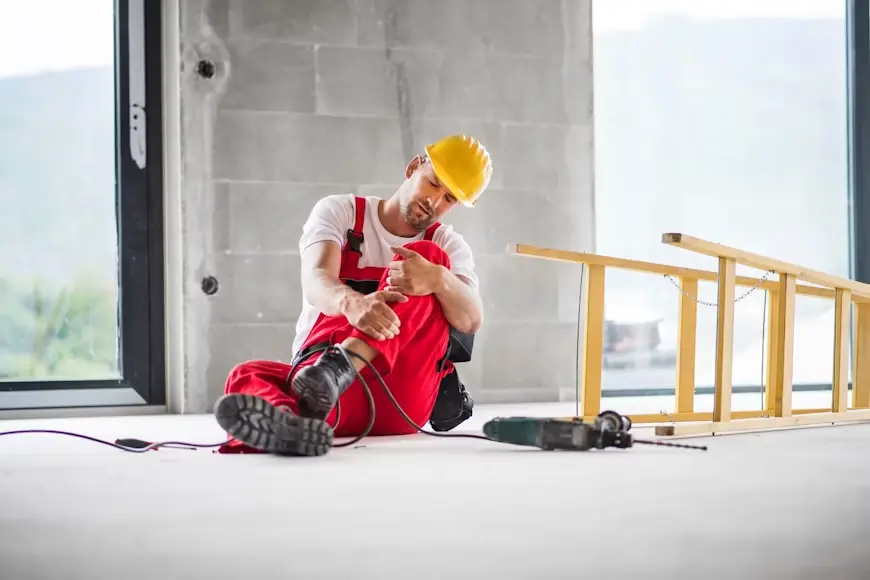
Since HB 837 took effect in March 2023, Florida applies a modified comparative negligence rule under §768.81: if you are found more than 50% at fault, you recover nothing, and Florida no longer applies joint and several liability, meaning each liable party is generally responsible only for their own proportionate share of fault rather than the full damages amount. HB 837 also shortened Florida's statute of limitations for most negligence claims from four years to two years under §95.11. For claims involving defective equipment, Florida's product liability framework, including the statute of repose covered on our product liability page, may also apply.
Understanding the Workers' Compensation Lien on a Third-Party Recovery
When an injured worker pursues both workers' compensation benefits and a third-party negligence claim for the same accident, the workers' compensation carrier generally holds a lien against any third-party recovery, a right to be reimbursed from the settlement for benefits already paid. This lien does not eliminate the value of pursuing a third-party claim, since third-party recoveries typically include pain and suffering and other damages workers' compensation never provided in the first place, but it does affect how a settlement gets structured and distributed. Negotiating this lien down is a routine but important part of maximizing what an injured worker actually keeps from a third-party settlement, and an attorney experienced in coordinating both claims simultaneously can often resolve the lien more favorably than a worker attempting to navigate both systems alone.
Undocumented Workers Have the Same Legal Rights After a Construction Accident
Florida's construction industry employs a significant number of workers whose immigration status is undocumented, and a widespread misconception is that this status eliminates their legal rights after a job site injury. It does not. The Florida Third District Court of Appeal confirmed in HDV Construction Systems v. Aragon (2018) that undocumented workers retain the right to both workers' compensation benefits and third-party personal injury claims arising from a workplace injury, the same as any other worker. An employer or third party cannot use a worker's immigration status as a shield against liability for an on-the-job injury they caused.
Wrongful Death Claims Following a Fatal Construction Accident
When a construction accident results in a worker's death, Florida's Wrongful Death Act allows the deceased's personal representative to pursue compensation on behalf of surviving family members, in addition to any workers' compensation death benefits available. These cases require the same third-party liability analysis as a survivable injury claim, identifying every subcontractor, equipment manufacturer, or other party whose negligence contributed to the fatal incident. Our Orlando wrongful death lawyer team handles these claims with the thoroughness they require, and for surviving workers left with life-altering permanent injuries rather than a fatality, our Orlando catastrophic injury lawyer team applies the same investigative approach to maximize long-term compensation.
What to Do After a Construction Accident in Orlando
- Report the accident to a supervisor and request an official incident report. This creates a timestamped record independent of any single company's internal account.
- Seek medical care immediately, and follow through on all recommended treatment. This protects both your health and the strength of any workers' compensation or third-party claim.
- Photograph the accident scene, equipment involved, and any visible hazard before conditions change. Construction sites are cleaned up and altered quickly.
- Identify every company working on the site, not just your own employer. Subcontractor names, equipment operators, and site supervisors from other companies are all potentially relevant to a third-party claim.
- Speak with an attorney before assuming workers' compensation is your only option. Determining whether a viable third-party claim exists requires investigating the full job site relationship, not just your own employment status.
How Louis Berk Law Handles Construction Accident Cases
When we take on a construction accident case, we investigate the full job site relationship from the outset, identifying every subcontractor, equipment supplier, and property owner who may bear third-party liability separate from the injured worker's own employer. We secure OSHA inspection records and citation history, retain independent safety and engineering experts to evaluate what actually caused the accident, and coordinate with workers' compensation counsel to manage the lien process so more of the final recovery reaches our client. Attorney Louis Berk reviews every case personally, applying the same multi-employer worksite analysis OSHA itself uses to make sure no potentially liable party is overlooked simply because they were not the worker's direct employer.
We have handled construction accident claims throughout Central Florida involving scaffolding collapses, trench and excavation failures, crane and rigging incidents, and unguarded fall hazards, and we know how to build a strong third-party case even when workers' compensation has already limited what the injured worker's own employer can be asked to pay. We represent workers across every trade, electricians, drywall installers, ironworkers, and general laborers, and we understand that the specific hazards and third-party relationships differ meaningfully from one trade to the next. You can review our case results to see how we've approached similar claims.
Disclaimer: This page is for general informational purposes only and does not constitute legal advice. Every case is different. For advice about your specific situation, contact a licensed attorney. Prior results do not guarantee a similar outcome.

Frequently Asked Questions
What if a construction accident resulted in a worker's death?
What if my construction accident was caused by extreme heat?
Will pursuing a third-party claim affect my workers' compensation benefits?
What if I'm undocumented? Can I still file a claim?
How do OSHA violations help my case?
Is the general contractor automatically protected from lawsuits?
Who can I sue if I can't sue my own employer?
Can I sue my employer after a construction accident in Florida?
***By providing a telephone number you are consenting to be contacted by SMS text message. Message & data rates may apply. You can reply STOP to opt-out of further messaging and get more help by sending HELP.
